Sunday, December 21, 2008

The death of PC gaming and the rise of the netbook

WARNING: The following post may contain technical terms that you will have to Google.  If you think your computer is run by magic faeries and a pinch of gold dust, you might want to skip this one.

I love games.  I play both computer (Windows PC) and video games (Wii and PS3), and I have done ever since my family had a computer (1996 or thereabouts).  However, there is a definite trend in the games industry away from computers, and towards console games.  To me, this seems a bit odd; most people already own computers, many computers are as powerful, if not more so, than current-generation consoles (especially the Wii), and wouldn't you think it would be cheaper and easier to consolidate one's games into one system, the computer?

Console game sales far outpace sales of computer games.  The Entertainment Software Association, or ESA, quotes statistics that support this claim: in 2007, console game sales accounted for $8.64 billion, while computer games accounted for a comparatively measly $910 million.

I think that there are a few reasons for this decline in PC gaming vis-à-vis console gaming.  The first is that dreaded and sick thing known as "Recommended System Requirements."

I remember trying to convince my parents to let me get a console when I was 12.  My main argument centered around the statement "there are no system requirements!  It always runs!"  This is my biggest beef with computer games, and I think it may have led to the downfall of the platform.  Console games, besides the fairly obvious "this game runs on this system" sticker on the front cover, have no system requirements.  It's either on such-and-such a system (and at full quality), or it's not.  

PC games, in contrast, come with a rather cryptic message on the bottom of the box that has a list of the "minimum requirements" (ie whether or not you can load the menu screen) and the "recommended requirements" (ie whether or not you can actually run the game).  You have to actually know what kind of processor you have, how much RAM you have, what video card you have, and what speeds they all run at.  You have to actually know how your computer works!  Oh noes!

In my experience with computer games, I have bought a game, taken it home, and installed it, only to find that that it either doesn't run at all or that it runs at such low quality as to make it virtually unplayable countless times.

Console games?  No problem.  Go to the store, buy the game that says "I run on your console!", pop the disc in, and bingo!, you're playing within five minutes.  No long installs (well, not until recently, anyway), no system requirements, no pain.

The second reason that I believe computer games are on their way out has to do with hardware.  Video game consoles have pretty much the same hardware, no matter what version of a platform you buy (yes, there are occasional updates, but for the most part they consist of nothing more than a new DVD drive, or a slightly faster processor).  PCs, on the other hand, are constantly being updated.  New graphics cards (arguably the single most important factor in how a computer runs a game) come out almost monthly; Intel and AMD (the two major processor manufacturers) release new processors regularly; new standards of RAM (random access memory, the stuff that stores data temporarily, as opposed to the hard drive, which stores things permanently) come out yearly.  The only thing that doesn't seem to change constantly in a computer is the hard drive.

Like all Apple products, PCs are obsolete almost the moment you buy them.  Because of the lack of a standard of hardware - a benchmark PC - games can, and do, vary over the entire spectrum of system requirements.  The prime example of this is a game called Crysis (pronounced like crisis).  Gamers love to poke fun at Crysis (in the way that school kids poke fun at the bully, but are secretly afraid and awed by him).  Crysis is consistently described as about two years ahead of current hardware and continues, a year after its release, to be the golden standard of extreme graphics on the PC, an amazing feat.

However, I have never seen a PC that could run Crysis at the highest settings.  They do exist, but they cost $5000 and up.

Who wants to constantly have to burn money on a computer to make sure that it can run the latest games?  Not I.  And, it seems, not the 38% of American households that own a video games console.

The third reason that "hardcore" PC games are going to die (which finally explains the title of this post) is that the world is transitioning away from big, powerful computers to small, portable, less powerful computers.  The "netbook" is a term coined fairly recently for the new category of computers with low-power processors and screens under 12" across.

I am typing this on a laptop, and although it's a huge 17" desktop replacement, the very fact that I own a laptop and not a more powerful desktop is an admission to the fact that I value portability more than power.

It is no coincidence that a "niche product" like the netbook exploded into the mainstream in the biggest year for video game console sales ever.  This is the point at which computers and games go their separate ways.  Video game consoles have and will continue to evolve into sophisticated multimedia centers, with games at their cores, while computers will evolve into more portable devices that center around interaction via the internet.

Indeed, some netbooks already blur the lines between the internet and a desktop environment.  Google recently announced a project, called Native Client, that would run x86 code (the types of programs that you run on your computer) inside your browser, which is presently limited to things like Flash or JavaScript.

Some may argue that games like World of Warcraft, which have an exclusively PC (and Mac) audience and are extremely popular, disprove this theory.  As much as I am inclined to dismiss these people as n00bs, they have a point.  WoW and other Massively Multiplayer Online Games (MMOs) have a tremendous audience on the computer.  However, new MMOs, like Bioware's the Old Republic, a Star Wars-themed MMO which has received a huge amount of hype, will be available on consoles as well as computers.  As internet connection speeds increase and MMOs become more hardware-intensive, the limiting factor of the graphics of PC MMOs like WoW will cease to be connection bandwidth and will become the actual video hardware of the machines they are played on.

Computers and consoles are headed in fundamentally different directions and only one can take gaming with it.  At the moment, it would appear that consoles have it mostly wrapped up.  Of course, what does it matter to Microsoft and Sony, the companies that make both our computers and our consoles if we have to buy one of each?

Friday, December 5, 2008

Metricate me, Cap'n!

To avoid any awkward confusion upfront, "metrication" is defined as "rewriting something in such a way that it is indecipherable to Americans" "the act, process, or result of establishing the metric system as the standard system of measurement."

The United States has officially recognized and endorsed the use of the metric system (officially the International System of Units - Le Système International d'Unités - or SI) since 1866.  However, it is one of three countries in the world that has not adopted it as its primary system of measurement (the other two are Liberia - a former US colony - and Myanmar).

This is not a post about how great the metric system is (very great), or why the metric system is better than the conventional system (it just is), or even how stupid the US is for refusing to adopt such a common sense series of units (quite stupid).  No, this post is none of these things because all of these things have been written about ad nauseam.

Essentially, the United States has refused to switch to the metric system because of a myriad of political and cultural reasons.  It is the only developed country in the world that has continued to use conventional units (with the quasi-exception of the UK), and most people tend to believe that metric units will continue to be used only in academia and technical fields like robotics and engineering.  However, I believe that the US could, and will, switch much faster, and much sooner, than is presently predicted.  And all because of the Internet.

North America has the highest percentage of Internet penetration in the world (73%); the United States alone has about 220 million Internet users.  Internet culture has blended so much with American culture that it is not uncommon to hear Internet expressions like "lol" or "1337" (pronounced "leet" and short for "elite" for all you non-1337 h4x0rz out there) used in everyday verbal conversations.  The Internet also uses metric.

Think about it; the hard drive in the computer you are reading this on is measured in gigabytes, the SI prefix giga, meaning "one billion," bytes.  My Internet connection is measured in Mbps - megabits per second (mega being the SI prefix for "one million").  The resolution of the photos you uploaded to Facebook the other day are measured in megapixels.  You use the metric system every day on a computer and on the Internet.

The international nature of the Internet also contributes to the metric influence.  Since so many (metric) countries are represented on the Internet, and since the Internet hosts content from all of them, it is inevitable that if one spends enough time on the Internet, one will encounter the metric system.

It is this subtle infiltration of America by the metric system that I believe will ultimately lead to a United States in line (literally) with the rest of the world.  90% of US residents aged 18-29 use the Internet, and so the metric system has finally learned what the Catholic Church has long known - "get 'em while they're young."  I foresee a kind of Glorious Revolution in which the metric system is finally introduced, in policy, as the primary system of measurement for the United States by the maturing Internet-age of Americans - those born 1992 (the birth of the World Wide Web) and later.

Gone will be the Carter-era pamphlets on "metrication" and a "metric future," to be replaced by...well, nothing.  We don't need propaganda to convince us to use the metric system, we already use it voluntarily with our computers and the Internet.  The Internet has brought the world together, and has (recently) begun the process of standardizing a compendium of knowledge and experience (including a system of measurement) that transcends national boundaries.  As high technology becomes more and more integrated within our culture, the metric system, the measurement scheme of high tech, will become integrated, as well.

Fear not the revolution, for it has already come.

P.S. Commenter Dr. Detroit makes a very good point, and I am reproducing part of his comment here: 
"There were many starts and fits in the direction of the metric system in the US since the fateful year of 1866 when it became legal throughout the land. A toxic combination of business lobbies (it's too expensive!), undereducated patriots (it's un-Amerikun!), and sheer inertia (imperial works, why bother?) has killed off any serious attempts at conversion several times. Although people may know their kilo-, mega-, and giga- prefixes thanks to PC's and the Internet, we still live in an America of 21-inch monitors, 3.5-inch hard drive bays, and hard-drive densities measured in bits/square inch." 
It is, sadly, true that high technology, because much of it is developed in America, is subject to the awkward dual use of metric and customary units.  I would concede the point that many measurements of high-tech devices are still measured in inches and other imperial units.  However, it is conceivable that we are in the first stages of a metric transformation that could be graphed as a parabola, that is, a transformation that starts slowly but builds upon itself to become a huge and significant force within a short period of time.  As the generations that never learned the metric system age (or as my mom so eloquently put it to me, "when I die"), the metric system may gain ground at an exponential rate (hence the parabola comparison).  Already we are seeing some small glimmers of hope as computer manufacturers have completely rejected the idea of using fractions of an inch in screen size measurements, in favor of the decimal system (ie .1, .2, .3, etc.) which is used by the SI.

Saturday, November 29, 2008

Consensus and the UN

Today, the United Nations is obsessed with consensus.  The ultimate goal of every debate on every issue is to reach a consensus.  Member nations have even gone so far as to include the word consensus in caucus names like "Uniting for Consensus" (which, admittedly, sounds quite a lot better than the caucus's former name "The Coffee Club").  Why do we lust after consensus, though?

Obviously, a solution that is agreeable to everyone is best, right?

Consider the following situation: nation A (let's call them Athens), nation B (Sparta), and nation C (Troy) all meet to try to come to an agreement on human rights.  Athens is a shining beacon of democracy in the world, they even like to spread the fantastic-ness of democracy to other countries.  Athens supports humanitarian intervention and human rights around the world.  Sparta, on the other hand, has a bit of a problem with a minority within their territory, a problem that the Spartans have decided to deal with by denying every human right to these citizens and initiating a campaign of ethnic cleansing.  The Trojans are the moderates: they support human rights, but not at the cost of national sovereignty.

Should Athens, Sparta, and Troy attempt to agree by consensus, anything they pass must meet only the lowest common denominator of the three doctrines on human rights and intervention.  Therefore, any resolution that the three pass will be completely ineffectual in practice, but will allow Sparta to continue killing their own citizens; Athens can proclaim a victory in the monumental passage of a resolution on human rights by consensus (every UN diplomat gets excited by that little buzzword); and Troy can claim to be the moderator, the calm and sage-like arbiter from whose fertile mind this consensus sprang.

Everyone wins!  (Well, except the Spartan minorities.)

This is the danger of consensus.  If everyone agrees, there is probably something very wrong, especially in an organization like the United Nations, which, by design, includes almost every possible viewpoint on almost every possible subject.

In fact, the UN Security Council veto power, an established power of the permanent five members of the Council that I am very much against, was established so that decisions could, and would, be made without consensus.  Unfortunately, the founders of the UN didn't foresee the P-5 being the very nations pushing for consensus and ignoring the plights of others.  Democracy is a great thing, but when it is in almost everyone's best interests to ignore a problem, or even worse, when they are encouraged to ignore a particular problem in order to reach the diplomatic Eden that is consensus, people suffer.

I've been trying to write a coherent post about the UN for a few days now, and I will probably write more on it in the future.  The UN would make great fiction - a struggle for international governance, rather than regional governance; the problems and conflicts that arise when governing a whole planet; even expansion to other planets.  I think the problem with people who like the UN (myself among them), is that we just can't comprehend why other people wouldn't want what we want - a more peaceful world(s) with better leaders and better living for all.  Maybe it's something about that whole having an omnipotent being/organization above you.  God doesn't seem to want to share, I suppose.

Friday, November 14, 2008

Musings on the World Wars

This past Saturday on KUNM, Radio Theatre played a PRX piece by Marjorie Van Halteren about the World Wars and the War in Iraq from the perspective of an American living in France.  In Europe, finding unexploded bombs from the pre-1945 era is commonplace, and there are special forces in both Germany and France that do nothing but round up and destroy these still-live explosives.  In fact, several years ago my paternal grandmother, who lived then in Leatherhead, England, called us up to tell us that an unexploded firebomb had been found under the floorboards of a shop in the town.

As Americans we never have to deal with the after effects of wars - especially those wars in which we were a combatant.  Since WWI, only one battle has been fought on US soil and none have been fought in the contiguous 48.  Finding a bomb in your back garden must really bring home the reality of a war that ended nearly 110 years ago.

Speaking of bringing things back to life, Kelsey has reposted a very interesting set of pictures from the First World War.  These photos are nothing special in terms of composition or subject matter - they depict soldiers in typical WWI uniform standing in trenches or sitting around - but they are in color, as almost no other photos of the Great War are.

I showed these pictures to my photo teacher, who asked if they had been hand-colored.  I don't think they have been, judging by the accuracy and the detail of the work, but I looked it up anyway.  As it turns out, a method of color photography was developed in 1907, just seven years before the outbreak of hostilities in Europe - autochrome.

The pictures, like the bombs and the radio piece, bring the World Wars slightly closer, subjectively, to modern times.  We can identify more easily with a color photograph than we can with a black and white one.  Perhaps things like these will help us avoid such a war in the future.  Maybe we will never have a war so horrible, so bloody, that it can be described by no other name than simply, "the Great War."  

Only if we remember these artifacts, these photos, these stories.

Sunday, November 9, 2008

Post-election politics, part II of several: Isn't this a bit premature?

I can't believe this.

Maybe I should have foreseen massive resistance to the election of the first black President in history, but I never thought people would be advocating impeachment before he's even taken office.

Two things about this bother me more than anything else: 
1) Impeachment is a serious thing.  It should not be thrown about or used to enforce "family values," lest it degenerate into something that the Congress is loathe to touch when it is actually needed.  I don't think we would be seeing this had McCain been elected.  Yes, we would see protest and anger, but not calls for legal impeachment.
2) This man is our President-Elect in a time that is perhaps the darkest in America's history since WWII or the Great Depression.  Obama hasn't even had a chance to do anything yet, and I think that when he is tested, he will show the world that he is the President that America needs.
[/partisanship]

Friday, November 7, 2008

Post-election politics, part I of several: Parties

This series of posts, "Re-examining the Election," will be my "super-post" about the election that I promised.  Tonight I will focus on the two party system that we have had for generations here in America.  George Washington warned against parties, but James Madison saw them as essential to a new type of democracy.  All democracies in the world (that I know of) have some sort of party system, but is there a better way?

Last night I was chatting with Kelsey of Plastick Manzikert and he brought up the religious right faction of the Republican Party and how he thought that this election would be the death knell of the religious right.

That would be great if it were true.

Overall, I don't think the Republican Party membership agrees with the religious right - at least, not the Ron Paul-esque factions of the party - but what ends up happening in elections is that religious right candidates and leaders get into positions of power within the party when they would not generally be accepted by a majority of party members.

This got me thinking - if party platforms were less catch-all and more specific, then we would have a more diverse set of parties to choose from and thus we would "weed out" the extremist factions from "mainstream" parties.  This is the kind of thing European governments do.

To which, of course, Kelsey replied "What about the FN in France [and the BNP and the UK]?  They still get 10% of the vote.  It means no power, but they are scary as heck."

Yes, diversifying and specifying does mean that we get some really scary parties out there, but it also means that they are isolated and can't worm their ways into mainstream, catch-all party leadership and run the country from there (think Karl Rove and Dick Cheney).  Not without a coalition, anyway.

OK, so smaller parties are better, but two major problems remain: 1) How do we change the election system to promote more parties?  After all, there is nothing in the Constitution that limits us to two parties (or mandates parties at all), so we must have arrived here somehow.  2) How do we deal with the election of an executive when no party receives an absolute majority of the vote (or something close to it)?

There is a principle in political science called Duverger's Law which states that an electoral system based on district plurality (like the electoral college, where the winner of a state gets all the electoral votes, no matter the margin of victory) or single-member district plurality (where specific districts individually elect their own representatives to a legislative body) will favor two parties or factions in the system.

Since I can't explain it any better, let me just give you the example from the Wikipedia page on Duverger's Law: 
Duverger suggested an election in which 100,000 moderate voters and 80,000 radical voters are voting for a single official. If two moderate candidates and one radical candidate were to run, the radical candidate would win unless one of the moderate candidates gathered fewer than 20,000 votes. Observing this, moderate voters would be more likely to vote for the candidate most likely to gain more votes, with the goal of defeating the radical candidate. Either the two parties must merge, or one moderate party must fail, as the voters gravitate to the two strong parties, a trend Duverger called polarization.

In addition to this effect of polarisation, Duverger also pointed out a purely statistical problem with single-member district plurality (SMDP): if a statistically significant third party is spread out over several districts, then no single district has enough support for that party to elect a representative from it.  This problem can be solved, but can also be created, with gerrymandering, the oft-criticized act of redistributing and redistricting to benefit or hinder on party or group of voters.

Now before you go around thinking that SMDP leads only to two parties, I have to point out that many successful multi-party democracies have SMDP systems; India, Canada, and the UK all have more than two statistically significant and politically significant parties.  The US, however, doesn't.

In every election since 1980, no third part candidate has received more than 3% of the popular vote, with the exception of Ross Perot, who received 18.9% of the vote in 1992 and 8.4% of the vote in 1996.  More significant in the American electoral system, no third party candidate has won a state, nor received an electoral vote (discounting faithless electors), since George Wallace won five states and 46 electoral votes in 1968.  No non-Republican/Democratic party candidate has won the Presidential election since Zachary Taylor, a Whig, in 1848 (at that time the Whigs were a main party).

So, how can we promote the growth of more (and not just more, but smaller and more specific) parties in the American electoral system?  Well, for a start we can get rid of the electoral college and the system of Congressional Districts.  Yes, they were a good idea when the fastest method of communication was a horse and rider, but today these are simply outmoded concepts.  

We should hold national elections for parties to see what percentage of the public actually identifies with a party's platform, not their candidate.  Assign seats in the Congress based on the national results of this election, not individual state results (i.e. 45% Democrat, 30% Republican, and 25% Whig would yield 196 Democrats, 130 Republicans, and 109 Whigs in the House of Representatives and 45 Democrats, 30 Republicans, and 25 Whigs in the Senate).  This is called proportional representation (PR).  Distribution of the Representatives would still be based on population, and the individuals could still be elected by their respective state parties or local district parties, but this ensures that no gerrymandering to disenfranchise third parties could occur.  This might work, though not as well, on a state-by-state level.

Also, a problem that has grown in recent years, but was not even imagined in colonial days, is that of campaign finance.  I realise that I'm reprimanding my own party here, but I don't think that one party or candidate should be allowed to massively outspend the other.  Much as I love the things the Obama campaign and the Democratic Party have been able to achieve with the millions upon millions of fundraising dollars that they received this election cycle, I don't think it was very fair.  I think that it is every citizen's responsibility to find out as much as they can on a particular candidate; no party should have to plaster posters and fliers around and buy up as much television airtime as possible to inform a voter or scare them into voting one way or another.  If ignorant voters vote for someone out of ignorance, well then the country will be run by ignorant people.  You only get out as much as you put in.  But I digress.  

All candidates, in all races, should be publicly funded.  Either no outside funding should be permitted or it should be severely limited and regulated, as it is in France.  If you want to volunteer for a candidate, that's great, go out and do it.  Just make sure that everyone is on equal footing.  Historically this has been one of the biggest hurdles for third parties; they just can't afford to run campaigns.

On the fiscal side of things, though, funding ~15 parties through a primary season all the way to the election could get expensive for the government.  In that case, maybe some tax should be instituted to pay for campaigns, or maybe campaigns should be funded 50/50 publicly/privately if they receive a required amount of the vote.  NO MORE HUGE, LONG PRIMARY SEASONS!  Campaigning should begin maybe in April, at the earliest.  Not only would this save a heck of a lot of money, it would save us all the headache of having to watch political careers go down in flames as well as preventing long, drawn-out party infighting.

OK.  Well then, on to question two.  How do we deal with the election of an executive when no party receives an absolute majority of the vote (or something close to it)?

This is a difficult question.  In other developed democracies, Prime Ministers are appointed by the ruling party or coalition (a subject for another post) or a President is elected via a system of run-off elections which progressively eliminate candidates until only one is left (wouldn't that be a fun reality show?  Run-Off Terror!).  I think that perhaps the latter would be more appropriate for the United States, but then again, we also have a provision in the Constitution that deals with the possibility of no candidate receiving a majority of electoral votes that could be easily adapted to fit a system without the electoral college.

Article 2 of the United States Constitution on the election of the President and the breaking of ties:
if there be more than one who have such Majority, and have an equal Number of Votes, then the House of Representatives shall immediately chuse [sic] by Ballot one of them for President; and if no Person have a Majority, then from the five highest on the List the said House shall in like Manner chuse [sic] the President. But in chusing [sic] the President, the Votes shall be taken by States, the Representation from each State having one Vote; a quorum for this Purpose shall consist of a Member or Members from two-thirds of the States, and a Majority of all the States shall be necessary to a Choice. In every Case, after the Choice of the President, the Person having the greatest Number of Votes of the Electors shall be the Vice President. But if there should remain two or more who have equal Votes, the Senate shall choose from them by Ballot the Vice-President.

This method could work in a popular vote system, and I think, considering the existing infrastructure and tradition, it would be the most practical.

Parties might also form coalitions to achieve greater amounts of power.  Allowing large coalitions would be a mistake in a new elections system.  Coalitions are simply another name for "big, catch-all parties," just like "factions" were for "parties" in the 18th and 19th centuries.  If coalitions with large, moderate member bases and radical leadership get into power, they could do some nasty things.  I'm all for majority rule, but coalitions are a perversion of majority rule in that the few control the many, who in turn control the even many-er.  If that makes sense. 

As you may have noticed, quite a bit of my proposed electoral system comes courtesy of France.  France has a very good elections system, I think, especially with regard to campaign finance and advertising (there is no TV advertising, only government-regulated news coverage where everyone gets exactly the same amount of time, and no candidate can use the French colors of red, white, and blue in their campaign material).  Maybe we should learn something.  After all, our Constitution could stand an update, and the French have the most similar form of government (we did inspire their revolution, and they did make ours possible).

Well, that post was long enough, so I think I'll finish it here.  I have more post-election issues to discuss, but those can wait for another day.

Saturday, November 1, 2008

McCain on SNL

As a general rule, you don't make fun of yourself on national television until after you've lost an election.  John McCain seems not to have recieved that memo.

I'll make this short, because I want sleep, but McCain appearing on SNL tonight was a new low for American politics.  Isn't it kind of pathetic that McCain had to go to "the liberal media" (especially the hated NBC) to get some free publicity for his campaign three days before the election?  

That last bit, I think, is the most important.  If McCain had been on SNL a month or two before the election, then it might be different.  However, his appearance tonight, less than 72 hours before the polls close in the East, screams "desperate" to me.  I don't want to get too confident, but if I were his campaign advisor right now, I'd be calling a preacher to excorcise the stupid out of him.

The US votes and the rest of the world watches

The World wants Barack Obama to win this Tuesday.  By "The World," of course, I mean the citizens of other countries who can't vote in the upcoming US elections.  Don't believe me?  US News and World Report says reported that
If the foreign diplomats in New York for the opening of the United Nations General Assembly late last month could [vote], they'd go for Sen. Barack Obama.
BBC News's poll of 22,500 people in 22 countries confirmed that Obama is "favoured by a four-to-one margin."  The Guardian, in association with eight other newspapers, including Le Monde (France), Yomiuri Shimbun (Japan), La Presse (Canada), and Reforma (Mexico), corroborates these results.  Gallup polls conducted in 73 countries have shown a 3-1 margin of support for Obama.  I think the evidence speaks for itself, but at the risk of being redundant I shall say again that the World wants Barack Obama to win.  

Why do they want him to win?  What is so different about Americans that we are don't have these huge polling margins for Obama?  Perhaps we see something, a darker side to Obama, or a lighter side to McCain, that the rest of the world doesn't see.  Perhaps the polls were rigged by communists.  Plausible theories, all.  However, I think that these polls reflect a fundamental difference in values between American and the rest of the world.  We've seen this kind of split before - on climate change, on the International Crminal Court, on Iraq, on the United Nations, ad infinitum - but we have never seen it on a "domestic" issue.

We've never seen the world so interested in a domestic American issue before because the President of the United States has never been the position it is now - the election of a President is now an international issue because of the power weilded by the office-holder.  The President apparently has the authority to violate national sovereignty, dismiss members of international border councils, and break US soldiers out of international jails.  The title "the President of the United States" is barely adequate nowadays, as it implies both parity with the heads of state of other nations and a limitation of power to American soil - neither is true.

Yes, you can call the occupant of the office of the President "the Leader of the Free World," as they have been since the Cold War, and it's true that the President weilded an immense amount of international clout in the '50s through the '90s, but in the post-9/11, post-Bush world where "the US sneezes and the rest of the world catches cold," the rest of the world is just as invested, and perhaps more so, as America is in this election.

P.S.  Sometime I want to do a big post or a series of posts analyzing this campaign.  Maybe I'll get to it after Tuesday.

P.P.S. Tomorrow I'll be doing another post exchange with Kelsey over at Plastic Manzikert.  It's something different, but I think it's really quite interesting, so do tell me what you think, all three of you.

P.P.P.S.  This post was inspired by a very good article by Andrew Rawnsley of the Observer (UK) about Barack Obama and his rather surprising campaign.  I encourage you to read it, not just because it's damned good, but because it gives another perspective on the American race for the White House.  Speaking of new perspectives, if you haven't already, check out the Onion's coverage of "The War for the White House," it's very entertaining and truthy.

Thursday, October 30, 2008

Photo-ness

So I shot and printed some more photos (I haven't been wasting all of my time!) and here they are, well, the best-ish, anyway:


(For some reason Blogger hates this photo.  Ignore the uploading artifacts.)


Monday, October 27, 2008

I'm Voting For Robin Hood in '08

Taking from the rich and giving to the poor is an idea, part of the Robin Hood folk myth, that has been ingrained in our culture.  We love to root for the "good guy" - Robin Hood - while we revile the Sheriff of Nottingham and Guy of Gisborn.  And that is as it should be.  However, we can change the terms just a little bit - make Robin the government that raises taxes on the rich to help the poor and make the Sheriff and Guy the politicians (I swore to myself I wouldn't use any modern names in this first bit) who want to keep the money where it is, and suddenly Robin isn't the good guy anymore.

Effectively, Robin Hood is redistributing wealth to the bottom 90% of Nottingham.  This redistribution is exactly the kind of thing that Republicans have been slamming Barack Obama for even suggesting in attack ads for the past few weeks.  Ever since I saw the first ad, I have been disgusted by them.

Redistribution of wealth is not a bad thing.  It would allow us to ensure that in our society everyone has a decent standard of living because, let's face it, not everyone in America has a decent standard of living.

I know this is political heresy and I will never be able to run for office in this country after saying it, but those people who "pulled themselves up by their bootstraps" to become part of the higher echelons of society should be taxed to allow others to attempt to pull themselves up.  The fact is that 99.9999999% people who live in poverty aren't living in poverty for lack of a will to work hard or to get a job, they just cannot, under current economic and social conditions, make enough to propel themselves out of poverty.  That needs to change.

America needs to tax it's more well-off citizens to provide universal health care, daycare for children, etc.  Civic virtue plays a role here.  Those better-off should help those not-so-well-off because it is their moral duty to do so, not because it benefits them economically (oh no, did I just invoke morals?  I thought only Republicans had those!).

Many people assume that the poor are taken care by not-for-profit organizations and volunteers.  Unfortunately, there are nowhere near enough volunteers and nowhere near enough money in non-profits to fix the huge problem of the class-gap between the very rich (who just seem to be getting richer) and the very poor (who just seem to be getting poorer) in America today.  Volunteerism doesn't cut it.  The government should stop using non-profits as its scapegoats, step up, and take responsibility for its own citizens.

A government's first responsibility is to provide for and protect its people.  We are currently failing the most fundamental mandate of any just government.  America could do with a little redistribution of wealth, and since money is power, if we redistribute the wealth back to the masses, if we take from the rich and give to the poor, then we, the people, get back the power.

And that's exactly what the rich and powerful are afraid of.

Sunday, October 26, 2008

Politics for the people

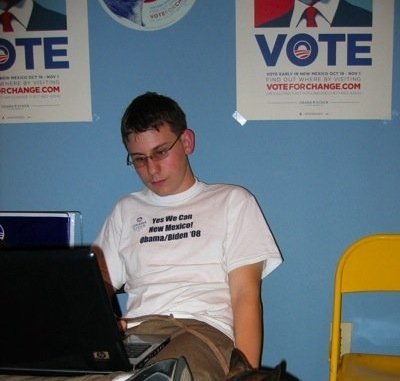
Although I'm a bit late to the party, I just wanted to mention that yesterday there was a huge Obama rally (link quotes sign as saying "We Need Change."  It actually read "Change We Need") on Johnson Field on the University of New Mexico campus.  By huge I mean 45,000 to 80,000 people huge.  That's almost a sixth of Albuquerque right there - an amazing feat for any event (Apparently this was the largest political rally ever in New Mexico, according to KOB-TV).

I was at the Obama rally as a volunteer, one of about 500 registering people to volunteer, assisting with the event, and generally doing anything we were told.  What struck me about the Obama campaign was its amazing organization and the way everything ran so smoothly with only a few days notice and preparation.

I am incredibly proud of this movement because this is truly a "grassroots" campaign.  We had volunteers of every age, every ethnicity, and just about every income level out there, working together for something they all believed in.  The raw energy of it was astounding.

I think that this campaign, if it successful, will do something more than simply "bring change to Washington;" I hope that this campaign will change the way campaigns are run.  We have the opportunity here to move away from a negative, top-down approach to political campaigns, and move towards positive, engaging, volunteer-supported, volunteer-driven, bottom-up campaigns that include everyone, not just "VIPs" or the party elite.  For too many years politics has been the domain of a privileged few.  Even the jargon of politics served to exclude people from the process.  Now, though, we can go back to the roots of mass democracy, something envisioned by James Madison way back at the founding of the United States.  

No one believed Madison that democratic-republicanism could be practiced with a large group of people over a large territory.  We can now, once and for ever, prove that Madison was right; we can practice real democracy, democracy where the most important thing is a single person with a single vote.  I'm not saying that party organization doesn't have its place, I'm saying that campaigns and parties should derive their powers from the same source that the government derives its powers: the people.

I realize this sounds as if I'm saying "go out and vote for Obama!  He's the only guy who really wants to listen to the people!"  And yeah...that's pretty much what I'm saying, I'm not going to deny it.

P.S. I've got pictures and a video of most of Obama's speech from last night that I will post as soon as I get it off the SD card.

Saturday, October 18, 2008

Firefly Post Exchange - Plastic Manzikert

The other day, Kelsey, the author of Plastic Manzikert and former editor of Foliage, suggested that he and I do a post exchange on our respective blogs on the subject of the sci-fi show Firefly.  I am a huge fan of Kelsey's work, and if you like the post below, go ahead and check out his blog here.

Firefly is my favorite piece of science fiction more or less ever. For the uninitiated, here's a few good quick links: more information than you require, less information than is helpful, and some (but not all) of the episodes available for free online. I'm assuming familiarity with the series for this post, so if you aren't familiar go ahead and watch it. All of it. It will make you very happy.

Like anything that I enjoy and can ponder for hours, Firefly has depth, and most interestingly political depth. Some of this is coincidental timeliness - the show premiered September 2001, and in the eight short years since then our own society has come to resemble fiction in startling ways. The most on-the-surface immediate reaction I get from the show in real life is the sight of blue gloves worn by TSA personal. In the show, these gloves are worn by government contractors on the hunt for a fugitive, and these contractors abuse habeas corpus, kill underlings, and are generally just dismissive of codes of conduct in their pursuit of their quarry. To see the same gloves on security personnel now kind of scares me.

There's more to Firefly's commentary than just prescient villains. The show takes place 6 years after a war between "The Allied Planets" and "The Independents". While the war is admittedly inspired by the US Civil War, the alliance/independent dichotomy strikes me as less of a historical fiction than a meditation on the fate of the United States.

The Alliance, you see, is a collection of prosperous and highly civilized planets, called the "core" (industrialized nations, or, alternatively, well-developed urban centers). The alliance has abundance, and with this abundance they have both a highly-functioning welfare state and a police state. The two, from the perspective of Firefly, are linked in such as way that they cannot function without each other. And in the brief glimpses we see of Alliance planets, it seems like a system that almost works - people are happy, private property is well protected, criminal behaviors are constrained by a system of digital monitoring all individuals, and there is a democratically elected Parliament in charge of everything.

But that's an almost. Throughout the show we see that there are flaws in this system. The government is far more secretive, functioning more less like a transparent democracy and more like a detached council (though perhaps this is how many already view the US legislature). The alliance provides competitive, free higher education for interested individuals, but at a high personal cost. Service to the higher echelons of government overrides local law enforcement always. Spoiler Warning: we see this as it regards distant planets in the episode "The Train Train Job", and we see it as it effects core planets in "Ariel". But that's the government functioning as one might expect, with some degree of secrecy and with priorities that don't immediately square with what locals want. Where the Alliance really breaks from good government is with corporations. Spoiler Warning for everything that follows.

In the first episode, the Firefly cast (also known as the crew of Serenity) are approached by a giant Alliance patrol. The patrol intends to arrest them for "illegal salvage", which brings to question what is legal salvage. While this question isn't addressed in the show proper, the answer is hinted at by the presence of the ubiquitous Blue Sun corporation. Blue Sun is a huge corporation, which does everything from sell canned goods to make t-shirts to employ blue-gloved individuals that hunt down fugitives as government contractors. In all the areas the government itself cannot function, government contractors are given authority, and they are even less accountable and are more subject pursue their objectives without attention to legal constraint. And then, in a flip, the contractors get to sue the government to enforce their monopolies against the public. The illegal salvage mentioned is not illegal because it is salvage (that is a necessary function in an interstellar economy, I imagine), but it is illegal because a contractors license wasn't obtained by those doing the salvage.

So that's the Alliance - rich, cultural imperialists who have the money and the desire to establish systems of both social welfare and social control, and who manage to afford all their excesses of power by employing contractors, corporations, and other extra-governmental bodies. Commentary, right?

This is contrasted with the Independents.

The Independents (and their veterans, known as Browncoats), are states rightists, libertarianistic, and self-deterministic. They believe in local rule, in minimal government, in self-sufficiency, and in individual freedom. Great as this sounds, in corporates a whole lot of nasty - indentured servitude, slaves, rule by arrogant local "Big Men", criminal empires, and some real hardship are all more or less a given in areas where Alliance control is weak, and Independent victory wouldn't have done much to curtail these problems. It's almost a hobbesian simplicity - where the government is weak, the people have no choice but to be strong or to die. On the other hand, those who can make it don't have to deal with anything more powerful than people. It's an intensified myth of the American fronteir, of the self-succificient American pioneer, and of self determination almost directly contrasted with democracy and power.

Firefly is, as I see it, the relevant narrative of this time, or at leasst of the past decade. The show existed before the Department of Homeland Security, and by the time the movie Serenity debuted (the show's sort-of sequal in film form) private military contractors working for the US government had been involved in battles in Iraq. Writing now in 2008, the US is beginning to look seriously at some form of Universal Healthcare and the government has pseudo-nationalized many major financial institutions. And this is also the era of Ron Paul, where a radical rightist can advocate a minimalistic government and draw large support from youths (who already have an unfavorable experience with provided services imposing major restrictions on freedom; i.e. public school).

For good or not, I think that the path as foreseen in Firefly is more or less clear for the United States. We've moved irrevocably away from yeoman farmers, and we've moved further still from an open lawless fronteir. The only option I see, even in the face of rising libertarianism and minimalist government backlash, is a carefully guided course of expanded government. The pitfalls to avoid are obvious, but I'll state them anyway - tranparency is the only safe way to guarentee more government power, and even that alone isn't enough. Private contractors have to be held to the same standards as governmental organs, and they have to be just as transparent. And we as a society are going to have to find some way to ward off a police state while moving into a welfare state. Firefly shows us a workable but broken model - the future isn't set, so there is no reason why we can't do better than fiction.