Showing posts with label democracy. Show all posts

Saturday, November 29, 2008

Consensus and the UN

Today, the United Nations is obsessed with consensus.  The ultimate goal of every debate on every issue is to reach a consensus.  Member nations have even gone so far as to include the word consensus in caucus names like "Uniting for Consensus" (which, admittedly, sounds quite a lot better than the caucus's former name "The Coffee Club").  Why do we lust after consensus, though?

Obviously, a solution that is agreeable to everyone is best, right?

Consider the following situation: nation A (let's call them Athens), nation B (Sparta), and nation C (Troy) all meet to try to come to an agreement on human rights.  Athens is a shining beacon of democracy in the world, they even like to spread the fantastic-ness of democracy to other countries.  Athens supports humanitarian intervention and human rights around the world.  Sparta, on the other hand, has a bit of a problem with a minority within their territory, a problem that the Spartans have decided to deal with by denying every human right to these citizens and initiating a campaign of ethnic cleansing.  The Trojans are the moderates: they support human rights, but not at the cost of national sovereignty.

Should Athens, Sparta, and Troy attempt to agree by consensus, anything they pass must meet only the lowest common denominator of the three doctrines on human rights and intervention.  Therefore, any resolution that the three pass will be completely ineffectual in practice, but will allow Sparta to continue killing their own citizens; Athens can proclaim a victory in the monumental passage of a resolution on human rights by consensus (every UN diplomat gets excited by that little buzzword); and Troy can claim to be the moderator, the calm and sage-like arbiter from whose fertile mind this consensus sprang.

Everyone wins!  (Well, except the Spartan minorities.)

This is the danger of consensus.  If everyone agrees, there is probably something very wrong, especially in an organization like the United Nations, which, by design, includes almost every possible viewpoint on almost every possible subject.

In fact, the UN Security Council veto power, an established power of the permanent five members of the Council that I am very much against, was established so that decisions could, and would, be made without consensus.  Unfortunately, the founders of the UN didn't foresee the P-5 being the very nations pushing for consensus and ignoring the plights of others.  Democracy is a great thing, but when it is in almost everyone's best interests to ignore a problem, or even worse, when they are encouraged to ignore a particular problem in order to reach the diplomatic Eden that is consensus, people suffer.

I've been trying to write a coherent post about the UN for a few days now, and I will probably write more on it in the future.  The UN would make great fiction - a struggle for international governance, rather than regional governance; the problems and conflicts that arise when governing a whole planet; even expansion to other planets.  I think the problem with people who like the UN (myself among them), is that we just can't comprehend why other people wouldn't want what we want - a more peaceful world(s) with better leaders and better living for all.  Maybe it's something about that whole having an omnipotent being/organization above you.  God doesn't seem to want to share, I suppose.

Sunday, October 26, 2008

Politics for the people

Although I'm a bit late to the party, I just wanted to mention that yesterday there was a huge Obama rally (link quotes sign as saying "We Need Change."  It actually read "Change We Need") on Johnson Field on the University of New Mexico campus.  By huge I mean 45,000 to 80,000 people huge.  That's almost a sixth of Albuquerque right there - an amazing feat for any event (Apparently this was the largest political rally ever in New Mexico, according to KOB-TV).

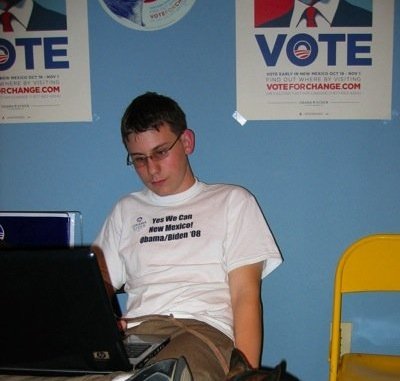
I was at the Obama rally as a volunteer, one of about 500 registering people to volunteer, assisting with the event, and generally doing anything we were told.  What struck me about the Obama campaign was its amazing organization and the way everything ran so smoothly with only a few days notice and preparation.

I am incredibly proud of this movement because this is truly a "grassroots" campaign.  We had volunteers of every age, every ethnicity, and just about every income level out there, working together for something they all believed in.  The raw energy of it was astounding.

I think that this campaign, if it successful, will do something more than simply "bring change to Washington;" I hope that this campaign will change the way campaigns are run.  We have the opportunity here to move away from a negative, top-down approach to political campaigns, and move towards positive, engaging, volunteer-supported, volunteer-driven, bottom-up campaigns that include everyone, not just "VIPs" or the party elite.  For too many years politics has been the domain of a privileged few.  Even the jargon of politics served to exclude people from the process.  Now, though, we can go back to the roots of mass democracy, something envisioned by James Madison way back at the founding of the United States.  

No one believed Madison that democratic-republicanism could be practiced with a large group of people over a large territory.  We can now, once and for ever, prove that Madison was right; we can practice real democracy, democracy where the most important thing is a single person with a single vote.  I'm not saying that party organization doesn't have its place, I'm saying that campaigns and parties should derive their powers from the same source that the government derives its powers: the people.

I realize this sounds as if I'm saying "go out and vote for Obama!  He's the only guy who really wants to listen to the people!"  And yeah...that's pretty much what I'm saying, I'm not going to deny it.

P.S. I've got pictures and a video of most of Obama's speech from last night that I will post as soon as I get it off the SD card.

Monday, August 25, 2008

Jumping Right In

I was going to have a whole post devoted to why I felt I should set up this blog, and it was all about how I felt "obligated to explain" etc. etc. Then, I suddenly realized, "wow, that's stupid." So I'm not going to do that. Instead, what I'm going to do is write a post on a discussion I had today at lunch on democracy's validity under certain circumstances.

"The best argument against democracy is a five-minute conversation with the average voter." - Winston Churchill

I love the quote above because it exactly captures my point in this post: uninformed voters invalidate the democratic process simply by virtue of making uninformed choices. Let me explain. Democracy is based on the simple concept of "by the people, for the people."

There is a thin line between "doing what is good for the people" and "doing what is good for the government." Sure, the two may be the same sometimes, but what is in the best interests of a government, even a democratically elected republic like the United States, is not necessarily in the best interests of its people.

In order to create and maintain a functioning government that is committed to doing right by its people, as much as is possible within the inherent constraints of a particular flavor of rule, those very people being governed, the ones referenced in the first three words of the United States Constitution, must be informed and up-to-date on current issues.

Even when there is not an imminent election, the citizenry must exist as a balancing force to the government. They must be aware of what is happening in the world, and not just by listening to what their government tells them. They must actively pursue knowledge of the world around them in order to ensure that the government they have entrusted with the reigns to the country is not mucking it up. This is their responsibility.

Without an informed and knowledgeable people, a democracy becomes nothing more than an oligarchy controlled by the elected. Yes, perhaps that is a bit of an oxymoron, but a true democracy requires active participation by the citizens, even if that participation is nothing more that watching out and making sure the government doesn't dig itself a hole to fall into or start turning into a global bully.

In essence, without an informed populace, a democracy is invalid because without that essential heavyweight of the people balancing the power of the government, the power all shifts to the government and the people forfeit all right they had to rule themselves and to overrule the government when it makes a decision that is not in keeping with its creed: by the people, for the people.